

Anxiety does not look the same for everyone.
One person may worry about work, money, health and family all day. Another may feel fine until they have to speak in a meeting. Someone else may experience sudden panic attacks without warning.
The main types of anxiety disorders include Generalised Anxiety Disorder, Social Anxiety Disorder, Panic Disorder, specific phobias and agoraphobia. OCD is also closely linked with anxiety, although it is now classified separately.
Understanding the pattern can help you describe what you are experiencing and find the right support.
Quick Answer: Which Type of Anxiety Sounds Most Like You?
If this sounds familiar It may resemble You worry about many areas of life and cannot switch them off Generalised Anxiety Disorder You fear being judged, embarrassed or watched Social Anxiety Disorder You have sudden attacks of intense fear Panic Disorder You experience intrusive thoughts and repetitive rituals OCD One object or situation causes intense fear Specific Phobia You avoid places where escape or help may feel difficult Agoraphobia The World Health Organization describes anxiety disorders as conditions involving excessive fear or worry that can interfere with everyday life.
1. Generalised Anxiety Disorder: When Worry Never Really Switches Off
Generalised Anxiety Disorder, often called GAD, is not worry about one specific problem. It is worry that moves from one concern to another.
You may start the day thinking about work, then shift to your parents’ health, finances, marriage, or whether you said the wrong thing during a conversation. Even when one issue is resolved, another quickly takes its place.
Common GAD symptoms include:
- Feeling tense or restless
- Difficulty sleeping
- Muscle tension
- Irritability
- Fatigue
- Trouble concentrating
According to the National Institute of Mental Health, the worry in GAD is difficult to control and often feels greater than the situation requires.
In India, GAD can hide behind very real concerns such as job security, family responsibilities or financial pressure. That is why people often say, “I have genuine reasons to worry.” The concern may be real, but the intensity and constant nature of the worry may still need attention.
2. Social Anxiety Disorder: When It Is More Than Shyness
Most people feel nervous before a presentation or when meeting new people.
Social anxiety disorder is different. It involves a strong fear of being judged, embarrassed or rejected.
It may show up as avoiding meetings, social events, phone calls, interviews or situations where people may be watching you. You might replay conversations afterwards and spend hours wondering whether you sounded awkward.
This is not the same as introversion.
An introverted person may prefer quiet settings. Someone with social anxiety may genuinely want to participate but feel unable to because the fear is too strong.
The NIMH explains that avoidance often brings short-term relief, but it can make social anxiety stronger over time.
In India, social anxiety is often dismissed as shyness, good behaviour or “not mixing with people.” That can delay support, especially for students and young professionals.
3. Panic Disorder: When Fear Arrives Without Warning
A panic attack is a sudden wave of intense fear that can feel physically overwhelming.
You may experience:
- A racing heartbeat
- Chest tightness
- Breathlessness
- Trembling
- Dizziness
- Nausea
- A feeling that you are losing control
Many people experiencing their first panic attack believe they are having a heart attack. Seeking medical help to rule out a physical cause is always sensible.
Having one panic attack does not automatically mean you have panic disorder. Panic disorder usually involves repeated, unexpected attacks followed by ongoing fear about having another one.
The NIMH guide to panic disorder explains that the fear of the next panic attack often becomes as disruptive as the attack itself.
4. OCD: Closely Linked to Anxiety, but Not the Same
Obsessive-Compulsive Disorder involves unwanted thoughts, images or urges called obsessions, followed by repetitive actions or mental rituals called compulsions.
For example, someone may repeatedly check whether a door is locked, wash their hands, seek reassurance or repeat phrases mentally to reduce anxiety.
OCD is not simply liking things neat or organised.
Although anxiety is a major part of OCD, current diagnostic systems classify it separately from anxiety disorders. The distinction matters because OCD usually needs a specialised treatment called Exposure and Response Prevention, or ERP.
If you think you may have OCD, look for a therapist who specifically mentions ERP training rather than general anxiety counselling.
5. Specific Phobias: When One Fear Takes Over
A specific phobia is an intense fear of a particular object or situation.
Common examples include:
- Flying
- Needles
- Animals
- Heights
- Blood
- Enclosed spaces
The fear is usually much stronger than the actual danger. People often organise their lives around avoiding the trigger, even when they know the reaction feels excessive.
Specific phobias respond well to gradual, professionally guided exposure therapy.
6. Agoraphobia: Fear of Being Trapped or Unable to Get Help
Agoraphobia is often misunderstood as a fear of leaving home.
It is more accurately a fear of being in places where escape may feel difficult, or help may not be available. This may include public transport, crowded markets, cinemas, queues or travelling alone.
Some people develop agoraphobia after panic attacks because they begin avoiding places where another attack would feel difficult to manage.
Where Does Exam Anxiety Fit?
Exam anxiety is not a separate diagnosis, but it can still seriously affect daily life.
For students preparing for JEE, NEET, UPSC, CA or board examinations, anxiety may be linked to performance pressure, fear of failure, family expectations or the belief that one result will decide their entire future.
It becomes more than ordinary nervousness when it repeatedly affects sleep, appetite, concentration or performance.
Our guide to Exam Anxiety in India explains how to recognise the difference between useful exam stress and anxiety that may need support.
For a broader overview of symptoms and treatment, read Anxiety: What It Is, Why It Happens, and How to Get Help in India.
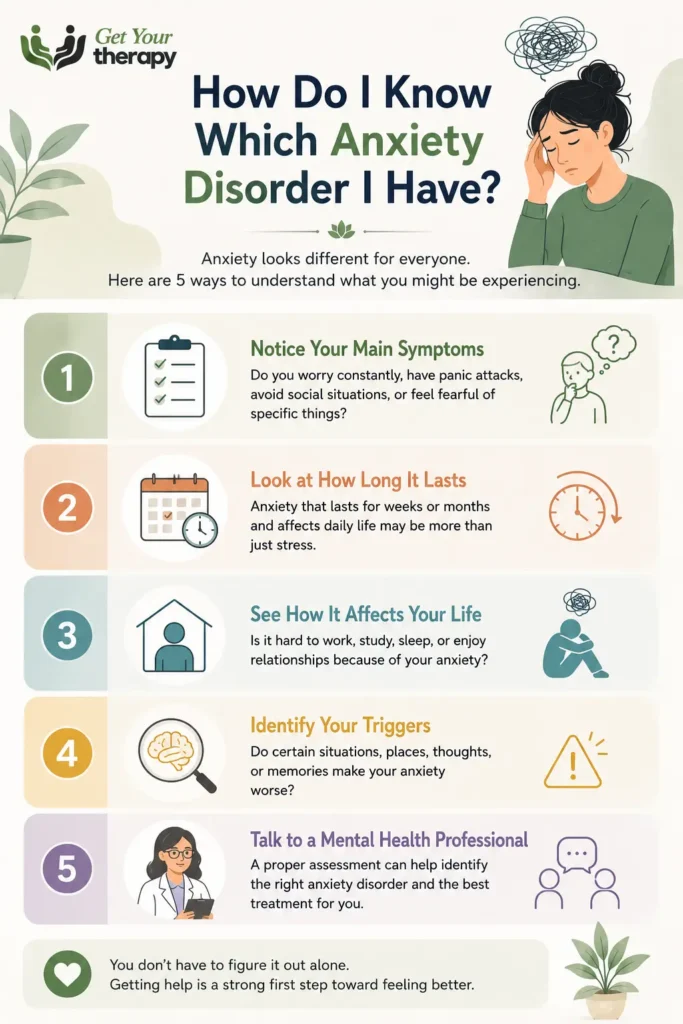
How Do You Know Which Anxiety Disorder You Have?
You do not need to diagnose yourself before asking for help.
A therapist will usually look at:
- What triggers the anxiety
- How long has it been happening
- What thoughts or physical symptoms appear
- What situations do you avoid
- How much does it affect daily life
Two people can both say, “I have anxiety,” while needing very different treatment approaches. That is why the specific pattern matters.
When Should You Speak to a Therapist?
Consider seeking professional support if anxiety:
- Has continued for several weeks
- Regularly affects sleep, work or studies
- Causes you to avoid serious situations
- Creates repeated physical symptoms
- Interferes with relationships or daily routines
You do not need to wait until anxiety becomes unbearable.
If you are ready to explore support, our guide on How to Find a Therapist for Anxiety explains what experience, qualifications, and therapy approaches to look for.
Ready to Understand What Your Anxiety Is Telling You?
You do not need to identify the exact label before asking for help.
A qualified therapist can help you understand the pattern, explain what may be happening and recommend the right treatment approach.
At GetYourTherapy, you can find anxiety therapists based on your concern, language, budget and availability.